Date:2026-11-16
Collaborative palletizing robots are used in most sectors that need to lift, move and stack goods onto pallets. The equipment helps automate the stacking step, reduces manual lifting, and standardizes how goods are arranged before storage or transport. What a robot can be applied to depends on payload, product size and gripper configuration.
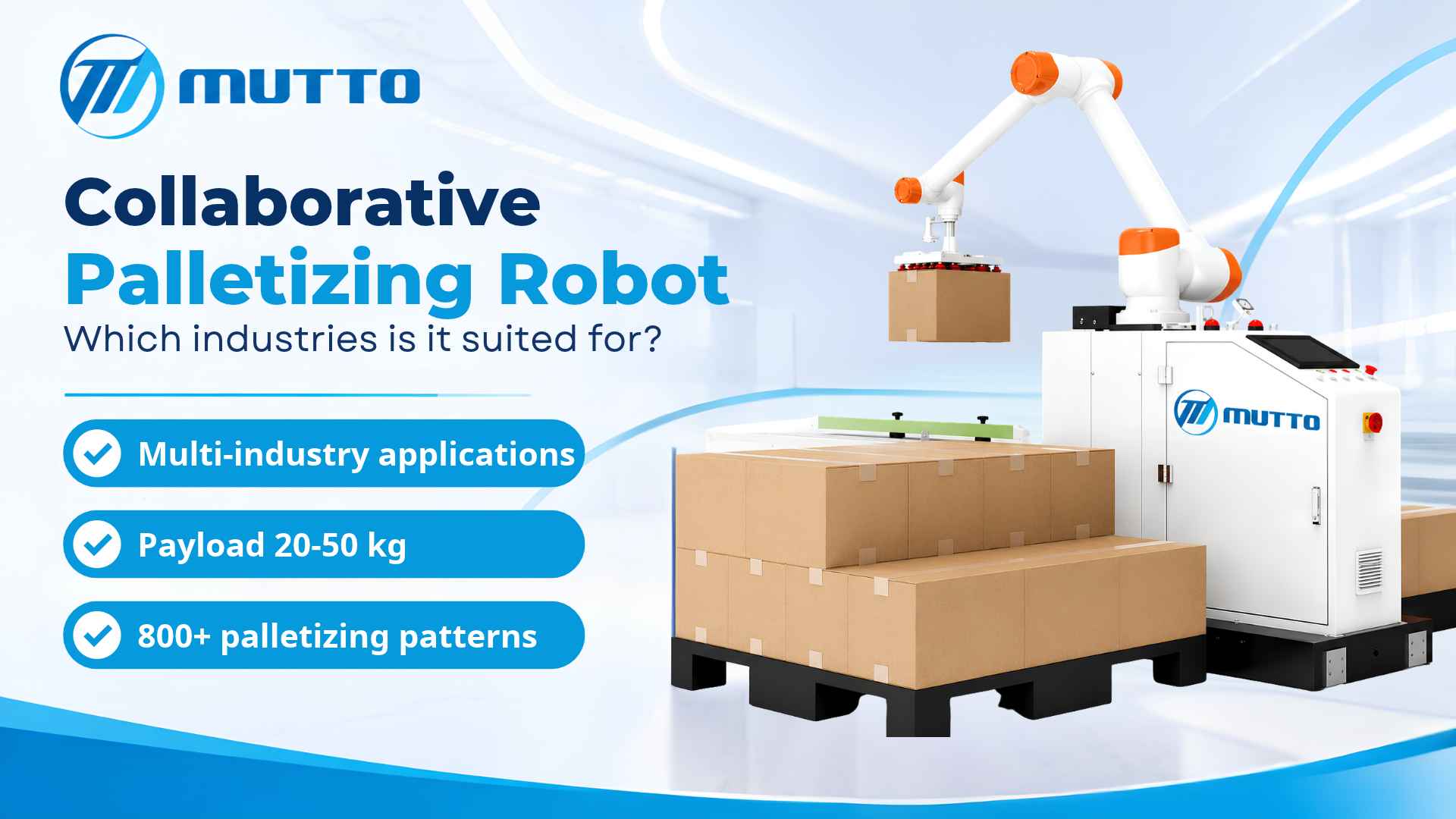
The sectors below commonly have a step where cartons or packages are stacked onto pallets at the end of the line. Depending on the gripper configuration, the robot can handle cartons, product boxes, packages or packaged products.
The scope of application is not limited to any one industry. However, each type of goods has its own weight, size, shape and stability. Businesses need to check load capacity, reach and gripper before choosing equipment.
A collaborative palletizing robot can lift, move and place goods according to a preset palletizing pattern. Depending on the product and configuration, the equipment can be installed at different stages of production.
Some typical applications include:
Stacking cartons after packaging: The robot picks up finished cartons at the end of the packaging line and places them onto the pallet one by one according to the preset pattern.
Transferring packages from conveyor to pallet: The robot receives products from the infeed conveyor, then moves and places them onto the pallet within the working range of the robot arm.
Handling multiple product formats: When a factory has many types of cartons or packages, the robot can use a different palletizing pattern for each product.
These applications reduce repetitive lifting and keep stacking consistent. However, the ability to handle each product type must be assessed based on total payload, size and gripper.
A factory should consider a collaborative palletizing robot when lifting and stacking happen frequently, are highly repetitive, or are labor-intensive.
Some signs that a factory may need to automate this step:
Workers frequently have to lift and stack heavy packages.
Large numbers of finished cartons or packages must be stacked every shift.
The palletizing step often becomes a bottleneck.
The factory needs to reduce manual handling at the end of the line.
The factory needs to standardize how goods are arranged before storage and transport.
Mutto’s collaborative palletizing robot range includes four models: MT-20-G, MT-30-G, MT-40-G and MT-50-G, with payloads from 20 kg to 50 kg, meeting a variety of stacking needs in production.
Mutto’s robots can store more than 800 palletizing patterns, recognize product orientation, and switch between single and double grippers. This lets a factory handle many product formats and change stacking plans to match production needs.
Businesses need to consider factors related to the product, throughput and operating conditions before choosing a collaborative palletizing robot.
Factors to evaluate include:
Workload: The number of cartons or packages to be stacked per shift.
Product weight: The robot’s payload must cover the combined weight of the product and the gripper.
Goods dimensions: Product size must fall within the handling range of the equipment and the gripper.
Processing speed: The robot’s stacking speed must meet the throughput required at the palletizing step.
Packaging characteristics: The shape, material and stability of the packaging affect gripper selection.
Installation space: The positions of the robot, conveyor and pallet must fit within the robot’s reach and working range.
Integration: Consider how the robot will connect to the conveyor and other equipment in the existing line.
In addition, businesses should consider equipment cost and expected operating efficiency before deciding.
Choosing a collaborative palletizing robot should be based on the characteristics of the goods, throughput requirements and operating conditions at the factory. Factories that need to lift, move and stack goods onto pallets can consider using robots, within the payload and size limits of the equipment.
Mutto’s collaborative palletizing robot range includes four models with payloads from 20 kg to 50 kg, meeting many automation needs in the factory. If your business is considering automating the palletizing step, send product samples and line information to Mutto for advice on a suitable configuration.
MUTTO (VIETNAM) MACHINERY EQUIPMENT COMPANY LIMITED
Address: 26-28-30 Street No. 7, Conic Residential Area, Hamlet 5, Binh Hung Commune, Ho Chi Minh City, Vietnam
Hotline: (+84) 917552177
Email: info@mutto.com.cn
Website: https://en.mutto.com.cn/
Facebook: https://www.facebook.com/MuttoFillingSolution/
Instagram: https://www.instagram.com/muttofillingsolution/
LinkedIn: https://www.linkedin.com/company/mutto-filling-solution/

Mainland China Region: Add:Building 6, No. 314 Shenxia Road, Jiading District, Shanghai
Tel:021-69896938
Vietnam Office: Add:26-28-30 Street No.7, Conic Residential, HoChiMinh City , VietNam
Tel:+84 917552177
Email: Email:info@mutto.com.cn
版权所有@2026牧东机械制造(上海)有限公司技术支持:撼云网络
 CN
 EN
 VI