Date:2026-11-12
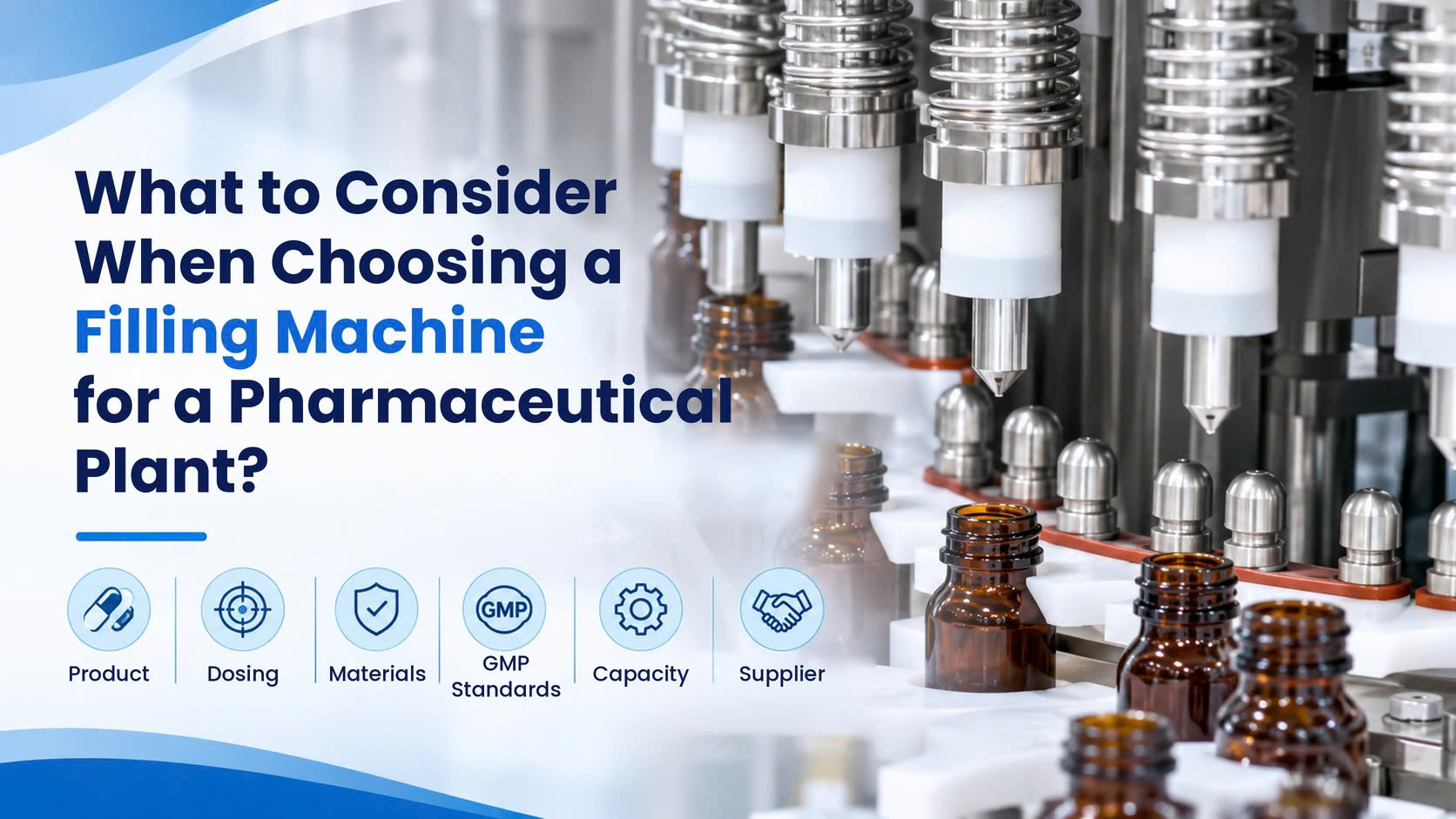
When choosing a filling machine for a pharmaceutical plant, manufacturers need to evaluate product characteristics, dosing accuracy, contact materials, cleanability and GMP requirements. Capacity, line integration capability and after-sales service are also factors to consider in order to keep the investment under control.
Product characteristics are the first factor to define, because they determine the filling method and the machine configuration. A pharmaceutical plant may produce oral solutions, syrups, antiseptic solutions, gels or ointments. Each product differs in viscosity, foaming tendency and chemical properties. Before requesting a quotation, manufacturers should define: Product state: liquid, viscous or containing particles. Viscosity and foaming tendency. Corrosiveness or reactivity with materials. Sensitivity to temperature and environmental conditions. Storage and hygiene requirements. For example, a high-viscosity syrup requires a pump mechanism that matches its flow behavior in order to maintain stable dosing. Products that foam easily require the supplier to consider filling speed and nozzle design. Manufacturers should send product samples or technical specifications to the supplier so that the proposed solution can be evaluated before the equipment is selected.
Dosing accuracy determines the consistency between product units and the ability to control quality. Commonly used filling methods include: The choice of method depends on the viscosity, fill volume and tolerance requirements of each product. Manufacturers should ask the supplier to explain the basis for the chosen method, and to run trials with the actual product to verify the dosing results.
Materials in direct contact with pharmaceutical products must be compatible with the product and must not affect the quality of the finished goods. SUS304 and SUS316 stainless steel are two materials that can be considered in machine design. Manufacturers should check the valves, piping, gaskets and filling nozzles, rather than looking only at the material of the machine frame. Factors to evaluate include: Whether parts can be disassembled for cleaning. Design that minimizes areas where product can accumulate. Cleaning procedures between batches. The possibility of using a CIP (clean-in-place) system. Methods for verifying residues after cleaning. According to WHO GMP guidance, pharmaceutical manufacturing equipment should be designed for easy cleaning and maintenance, and to minimize the risk of contamination and cross-contamination. CIP is not a mandatory requirement for every machine. Plants should choose a cleaning system based on the actual product and production process.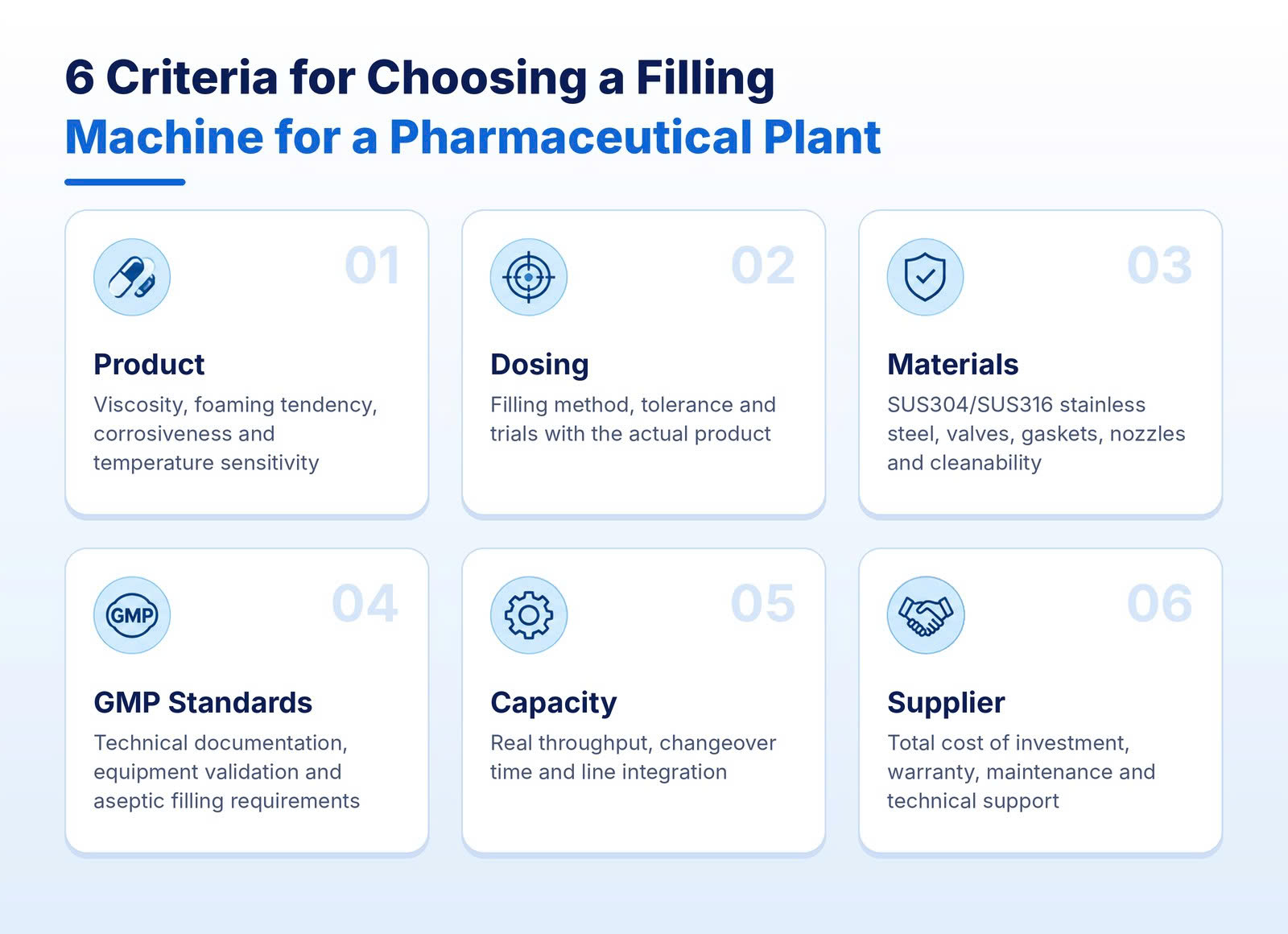
Manufacturers should define GMP requirements at the technical specification stage to limit retrofit costs after the machine is purchased. Topics to discuss with the supplier include: Equipment design and construction materials. Cleanability and maintainability. Control of contamination and cross-contamination. Technical documentation and operating manuals. Ability to support inspection, calibration and validation as required. In particular, manufacturers need to distinguish between a standard filling line and an aseptic filling line. If a plant produces injectable or other sterile products, the equipment must meet specific requirements for the environment, contamination control and process validation. According to FDA guidance, aseptic filling processes should be evaluated through simulation using microbiological growth media (media fill). Manufacturers should ask the supplier to confirm the equipment's scope of compliance and to provide the relevant technical documentation before making an investment decision.
Machine capacity must meet the target output and the operating capability of the entire line. Manufacturers should not compare only the maximum speeds announced by suppliers. Actual throughput also depends on bottle feeding time, product changeover, cleaning and downtime. Information to define includes: Target output per hour or per shift. Container sizes and number of container types. Cleaning and product changeover time. Capacity expansion potential. Ability to connect with existing equipment. When investing in a new line, manufacturers should evaluate the stages of bottle feeding, filling, capping, labeling and packaging as an integrated whole. When buying a standalone machine, the plant needs to check dimensions, conveyor speed and control connectivity with the existing system.
The purchase price is not the only cost manufacturers need to consider. Installation, operation, maintenance and spare parts costs should also be included in the total budget. Before signing a contract, manufacturers should ask the supplier to clarify: A machine with a low purchase price does not necessarily have a low total cost of ownership. Manufacturers should compare options based on configuration, service scope and long-term operating costs.
Mutto takes on filling projects for pharmaceutical plants and develops equipment solutions based on the actual requirements of each manufacturer. The consultation and project implementation process includes the following steps: Requirement intake: Define the product, packaging, volume and target capacity. Technical assessment: Review viscosity, filling method, materials and hygiene requirements. Solution proposal: Develop the equipment configuration and line scope. Implementation: Carry out design, installation and operator training according to the project scope. After-sales service: Receive and handle technical requests in accordance with the agreed warranty and maintenance policy. For pharmaceutical plants, requirements related to GMP, CIP, validation or aseptic filling are assessed separately for each configuration. Manufacturers should confirm the technical documentation and scope of compliance with the supplier before making an investment decision. Manufacturers looking for a filling machine for their plant can contact Mutto and provide information on the product, packaging and expected output to start discussing solutions.
Manufacturers should define product characteristics first, then choose the filling method and capacity. A high-capacity machine that does not match the viscosity or properties of the product may still run unstably. Not every application requires SUS316. The choice between SUS304 and SUS316 depends on the product characteristics, the contact environment and the plant's technical requirements. Not every filling machine needs CIP. Manufacturers need to evaluate the machine design, the cleaning process and quality control requirements in order to choose a suitable system. Manufacturers should prepare the product type, viscosity, fill volume, container type, target capacity and hygiene requirements. Drawings of the plant or the existing line also help the supplier assess installation conditions. The price depends on the filling method, capacity, number of filling heads, materials, level of automation and specific technical requirements. Manufacturers should request a detailed quotation by configuration in order to compare options.Should manufacturers define product characteristics or capacity first when choosing a filling machine?
Does a pharmaceutical filling machine have to use SUS316 stainless steel?
Does a pharmaceutical filling machine need a CIP system?
What should be prepared before requesting a quotation for a filling machine?
What factors affect the price of a pharmaceutical filling machine?
Choosing a filling machine for a pharmaceutical plant should start with product characteristics and production requirements, followed by an evaluation of dosing, materials, cleanability, capacity and investment cost. Manufacturers should also check the supplier's technical capability and after-sales service. Preparing complete product and packaging information will make the consultation and equipment selection process more effective.
MUTTO (VIETNAM) MACHINERY EQUIPMENT COMPANY LIMITED Address: 26-28-30 Street No. 7, Conic Residential Area, Hamlet 5, Binh Hung Commune, Ho Chi Minh City, Vietnam Hotline: (+84) 917552177 Email: info@mutto.com.cn Website: https://en.mutto.com.cn/ Facebook: https://www.facebook.com/MuttoFillingSolution/ Instagram: https://www.instagram.com/muttofillingsolution/ LinkedIn: https://www.linkedin.com/company/mutto-filling-solution/

Mainland China Region: Add:Building 6, No. 314 Shenxia Road, Jiading District, Shanghai
Tel:021-69896938
Vietnam Office: Add:26-28-30 Street No.7, Conic Residential, HoChiMinh City , VietNam
Tel:+84 917552177
Email: Email:info@mutto.com.cn
版权所有@2026牧东机械制造(上海)有限公司技术支持:撼云网络
 CN
 EN
 VI