
Date:2026-10-28
In modern production lines, the loading and palletizing stage is one of the key links that directly affects productivity, operating costs, and a company’s overall logistics efficiency. However, it is also a highly repetitive task that requires a large workforce and carries many risks when lifting and lowering goods.
With the advancement of industrial automation, many businesses are switching to automatic palletizing robots to replace manual operations, optimize production processes, and improve their competitiveness. With their precision, stability, and flexibility, palletizing robots are becoming an important part of smart factories, especially in pallet stacking, packaging, and internal transportation.
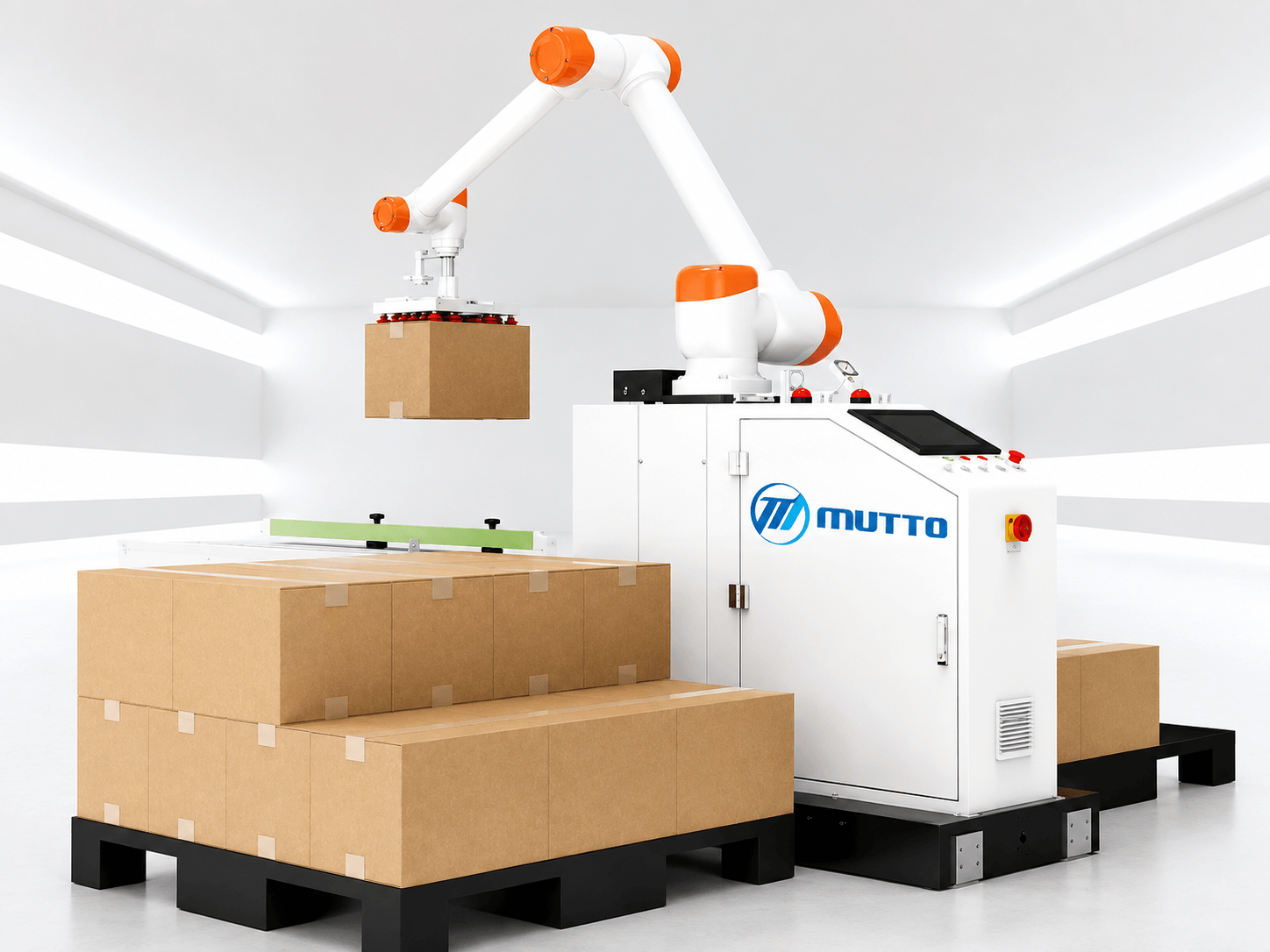
An automatic palletizing robot is a robotic system designed to pick up, lift, move, and arrange products onto pallets according to a pre-programmed routine.
Instead of relying on workers to continuously load and unload goods, the robot can handle products automatically at a steady speed, with high precision and the ability to operate for long periods.
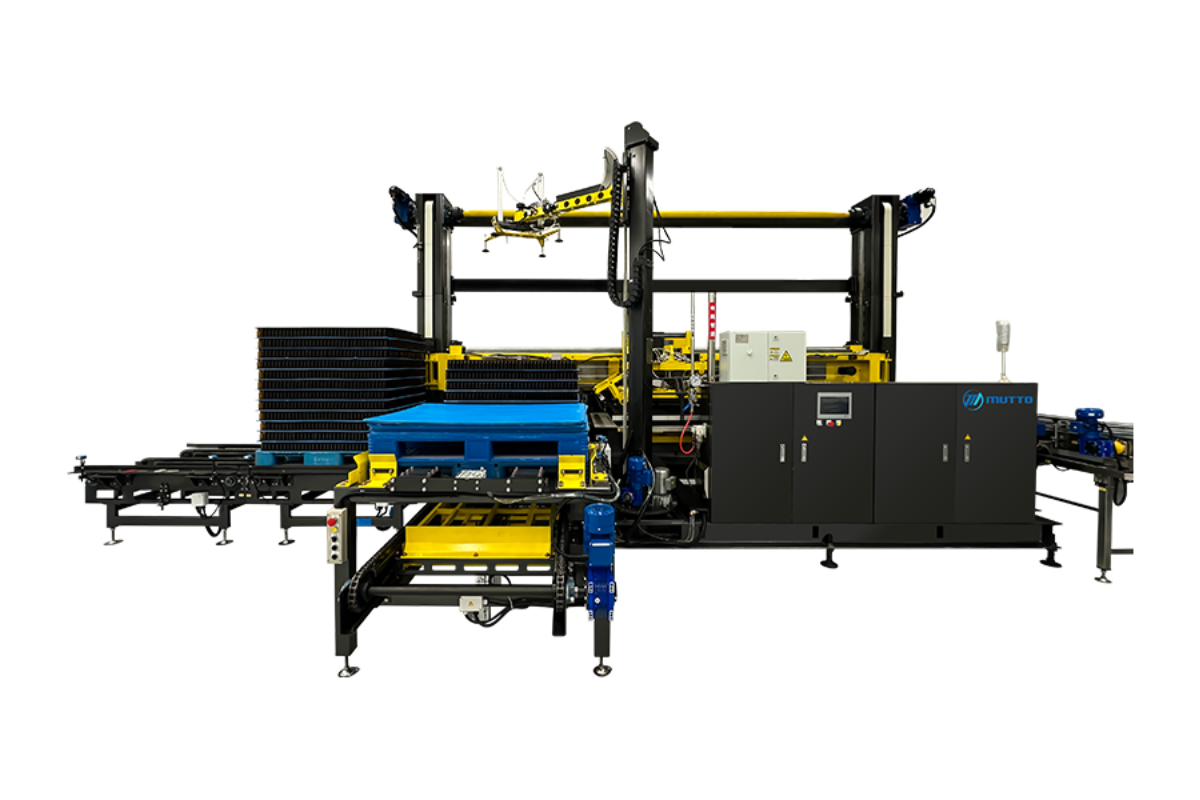
A complete palletizing robot system typically includes:
An industrial robot arm or collaborative robot (cobot).
A central controller.
A specialized product gripper.
Sensors and a camera recognition system.
An infeed conveyor.
A pallet placement area.
Control and operations management software.
Depending on the product characteristics and production requirements, the robot can be customized to handle many types of goods, such as:
Cartons.
Sacks and bags.
Product boxes.
Trays.
Packaged products in the food, electronics, chemical, and construction materials industries.
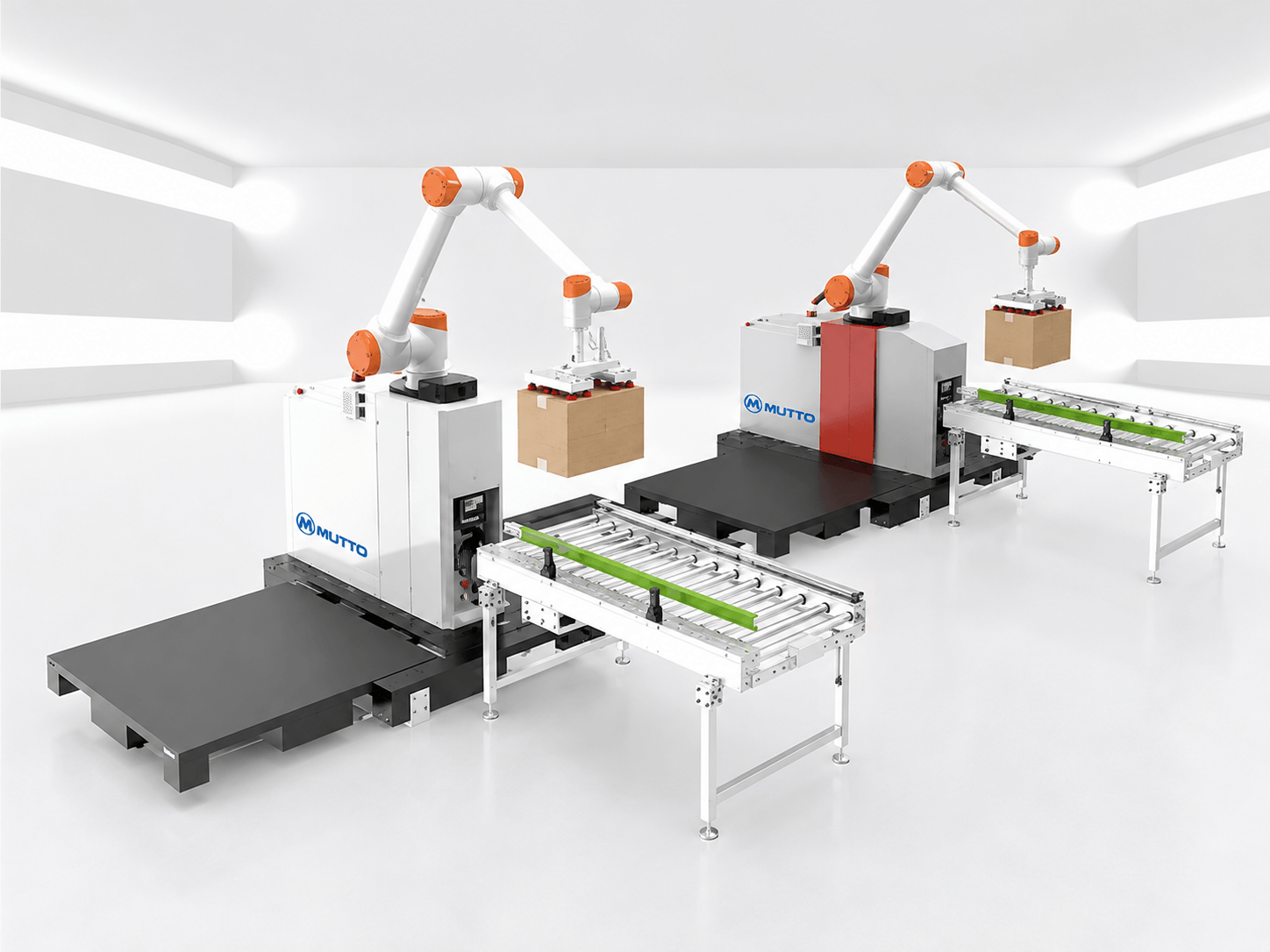
The operation of a pallet stacking robot is fully automated, through the combination of robot hardware and an intelligent control system.
Once production or packaging is complete, products are delivered to the robot’s work position via a conveyor system.
Sensors determine the position, size, and condition of each product so the robot can perform its movements accurately.
Based on its programming, the robot uses its gripper to pick up the product. Depending on the type of goods, businesses can choose:
Vacuum grippers for cartons and product boxes.
Mechanical clamps for sacks or heavy products.
Custom-designed grippers for specialized products.
The robot moves the product to the target position and arranges it according to the programmed pallet pattern. Stacking patterns can be adjusted to:
Optimize pallet space.
Ensure stability during transportation.
Suit each type of product.
Once a pallet is full, the system can work together with other equipment such as:
Automatic pallet wrapping machines.
AGV/AMR transport robots.
Smart warehouse management systems.
This allows businesses to automate the entire process from production to warehousing.
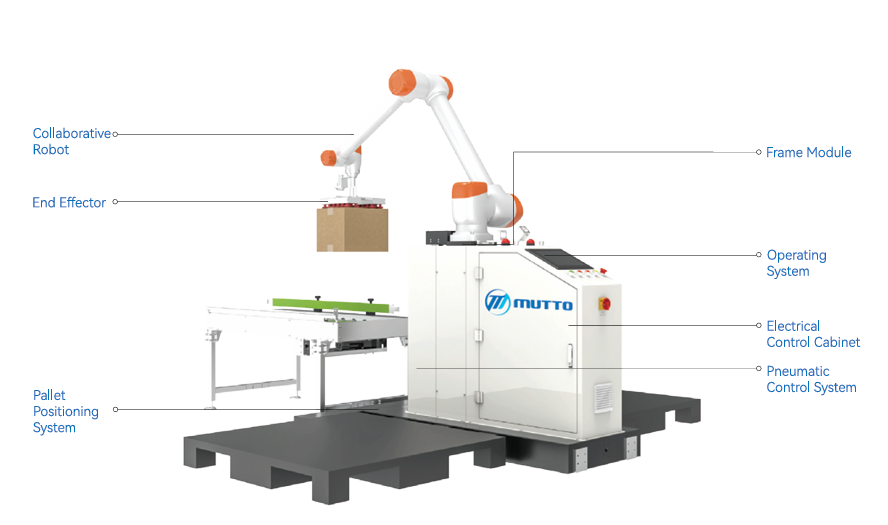
An automatic pallet stacking solution is not just a robot arm, but a combination of multiple devices that form a complete system.
This is the central component that picks up and arranges the goods. The robot is selected based on:
Product weight.
Required speed.
Factory space.
The volume of products to be handled.
The gripper determines the robot’s ability to handle products. A suitable gripper helps to:
Hold products securely.
Avoid damaging goods.
Increase handling speed.
The conveyor delivers products to the robot’s work area, keeping the operation continuous and stable.
For factories with high output, robots are often integrated with additional equipment such as:
An automatic pallet dispenser.
A stretch wrapping machine.
A goods inspection system.
This solution minimizes human intervention at the end of the production line.
Thanks to their flexibility and easy customization, automatic palletizing robots are widely used across many industries.
In industries such as cement, fertilizer, chemicals, and industrial raw materials, handling heavy bags often puts great strain on workers. Robots help to:
Automate the lifting and stacking of bags.
Maintain a steady working speed.
Reduce the risk of workplace accidents.
Improve production efficiency.
The food, beverage, FMCG, and electronics industries often have large numbers of cartons that must be arranged before shipping. Robots can:
Pick cartons from the conveyor.
Stack them in many different pallet patterns.
Adjust the program when the product changes.
This gives businesses greater flexibility when producing multiple product lines.
The current trend is to combine palletizing robots with AGV or AMR autonomous robots to create an automated logistics system.
Operating workflow: Production → Palletizing robot → AGV/AMR transport → Smart warehouse.
This solution helps to:
Automate internal transportation.
Reduce dependence on forklifts.
Optimize warehouse management.
Robots can operate continuously at a stable speed, helping businesses increase output without significantly expanding their workforce. Especially in large production lines, robots eliminate interruptions at the packaging and pallet stacking stage.
Using robots helps businesses:
Reduce labor costs in the long term.
Limit errors during stacking.
Allocate resources to higher-value work.
Because robots operate based on control programs, they can:
Stack goods uniformly.
Maintain pallet quality.
Reduce the risk of product damage.
Lifting and lowering heavy goods often causes health problems for workers. Robots reduce human involvement in heavy-duty work environments, thereby improving production conditions.
In the future, palletizing robots will continue to develop alongside the trend of building smart factories. Notable technologies include:
Cobots can work safely alongside humans, making them suitable for factories that need high flexibility.
Cameras combined with artificial intelligence help robots to:
Recognize products quickly.
Determine positions accurately.
Adjust their movements flexibly.
Modern robots can connect to manufacturing management systems in order to:
Monitor performance.
Analyze data.
Send error alerts.
Optimize operating processes.
With the shift toward smart manufacturing, investing in automatic palletizing robots is an important step that helps businesses improve their production capacity and optimize operating costs.
Mutto provides collaborative palletizing robots, automatic palletizing robots, and automation systems suitable for a wide range of factory models. Mutto’s solutions focus on:
Consulting on systems based on actual needs.
Designing robots suited to each type of product.
Integrating into existing production lines.
Supporting deployment and operation.
In the era of Industry 4.0, palletizing robots are not just a tool for replacing manual labor, but also a foundation that helps businesses build a more efficient, flexible, and modern production process.
Contact Mutto for consultation on automatic palletizing robot solutions that fit your production needs.
MUTTO (VIETNAM) MACHINERY EQUIPMENT COMPANY LIMITED
Address: 26-28-30 Street No. 7, Conic Residential Area, Hamlet 5, Binh Hung Commune, Ho Chi Minh City, Vietnam
Hotline: (+84) 917552177
Email: info@mutto.com.cn
Website: https://en.mutto.com.cn/
Facebook: https://www.facebook.com/MuttoFillingSolution/
Instagram: https://www.instagram.com/muttofillingsolution/
LinkedIn: https://www.linkedin.com/company/mutto-filling-solution/

Mainland China Region: Add:Building 6, No. 314 Shenxia Road, Jiading District, Shanghai
Tel:021-69896938
Vietnam Office: Add:26-28-30 Street No.7, Conic Residential, HoChiMinh City , VietNam
Tel:+84 917552177
Email: Email:info@mutto.com.cn
版权所有@2026牧东机械制造(上海)有限公司技术支持:撼云网络
 CN
 EN
 VI